
What Happens During a Spinal Fusion Surgery? | Best Spine Surgeon in Okhla
Introduction
Spinal fusion surgery is one of the most commonly performed procedures to treat debilitating back and neck conditions. Whether caused by degenerative disc disease, scoliosis, spinal instability, or a herniated disc that hasn't responded to conservative treatment, spinal fusion can offer lasting relief and restored mobility. If your doctor has recommended this surgery, it's completely natural to wonder — what actually happens during a spinal fusion surgery?
In this comprehensive guide, Dr. Abhinav Agrahari, a leading neurospine surgeon and the best spine surgeon in Okhla at Fortis Escorts Heart Institute, walks you through the entire process — from preoperative preparation to postoperative recovery — in clear, easy-to-understand language. Visit www.drabhinavagrahari.com to learn more or book a consultation.
What Is Spinal Fusion Surgery?
Spinal fusion is a surgical procedure that permanently joins two or more vertebrae in the spine, eliminating motion between them. Think of it as a "welding" process. By fusing the bones, the surgery removes the source of pain caused by abnormal movement or nerve compression, while maintaining the overall stability of the spine.
The surgery is used to treat conditions such as:
• Degenerative disc disease
• Spinal stenosis
• Spondylolisthesis (slipping of vertebrae)
• Herniated or bulging discs
• Spinal fractures or trauma
• Spinal deformities like scoliosis or kyphosis
• Tumors or infections affecting the spine
Before the Surgery: Preoperative Preparation
The journey toward spinal fusion surgery begins well before the operating room. Your spine surgeon will conduct a thorough evaluation, including X-rays, MRI scans, CT scans, and blood tests to map the exact problem areas and plan the procedure.
You will typically be advised to:
• Stop certain medications like blood thinners and anti-inflammatory drugs
• Quit smoking, as nicotine significantly impairs bone healing
• Fast for at least 8 hours before surgery
• Arrange post-surgery support for at least 2–4 weeks
A pre-anesthesia consultation is also performed to assess your fitness for surgery and decide between general or regional anesthesia.
Step-by-Step: What Happens in the Operating Room?
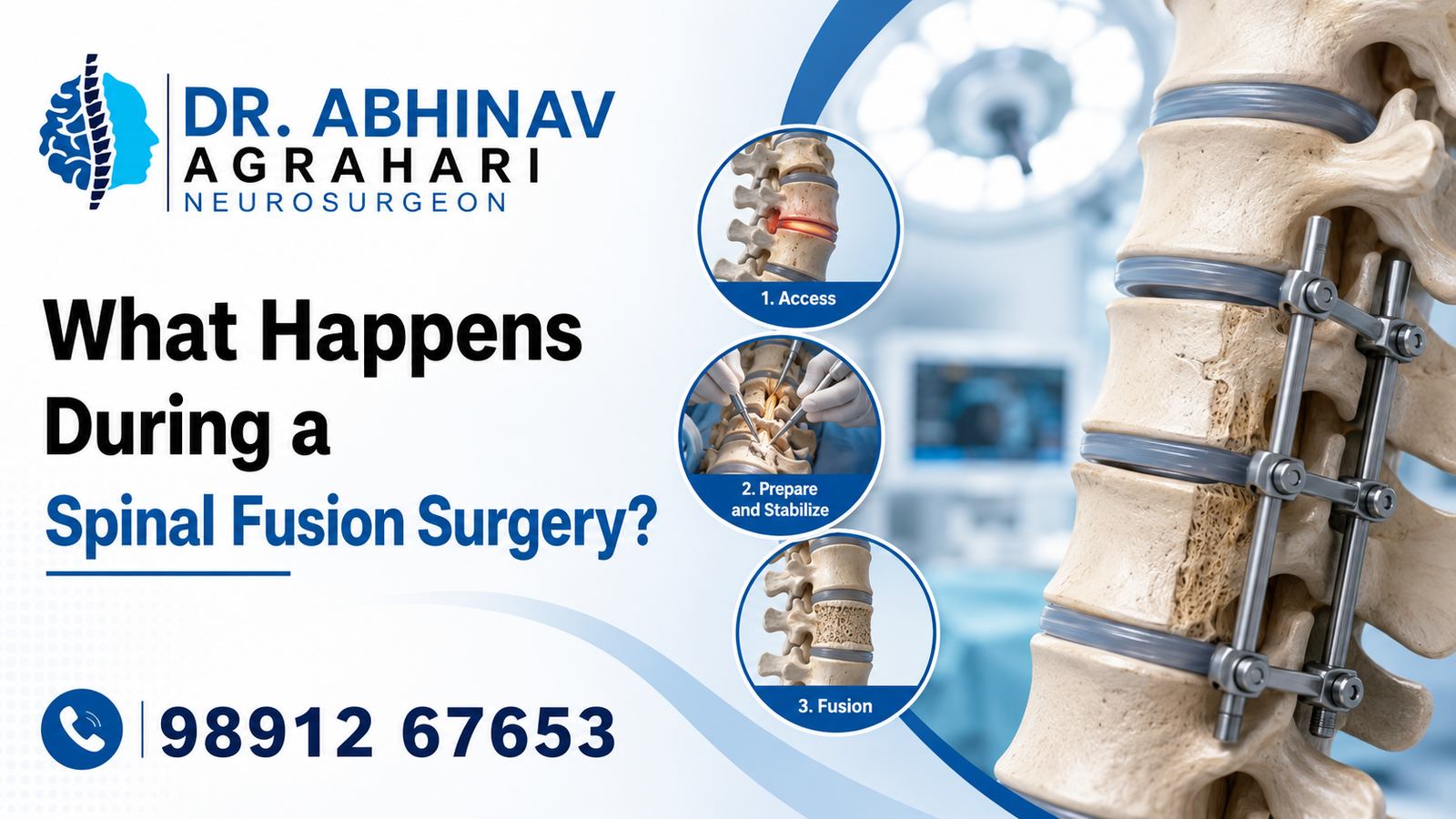
Step 1 – Anesthesia: Once you're on the operating table, general anesthesia is administered, ensuring you are completely unconscious and pain-free throughout the procedure.
Step 2 – Surgical Incision: Depending on the location of the affected vertebrae, the surgeon makes an incision either in the back (posterior approach), abdomen (anterior approach), or side (lateral approach). Minimally invasive techniques, often used by experienced spine surgeons, involve much smaller incisions with faster recovery.
Step 3 – Accessing the Spine: Muscles and soft tissues surrounding the spine are gently moved aside to expose the target vertebrae. In minimally invasive spinal fusion surgery, specialized dilators and tubes are used to minimize muscle damage.
Step 4 – Disc Removal (Discectomy): If a damaged or degenerated disc is causing the problem, it is completely or partially removed. This step relieves pressure on the surrounding nerves and creates space for the bone graft.
Step 5 – Bone Grafting: A bone graft material is placed in the disc space or alongside the vertebrae. The graft acts as a bridge that stimulates new bone growth between the vertebrae. The graft can come from:
• Your own bone (autograft) — usually taken from the pelvis
• A donor bone (allograft)
• Synthetic bone substitutes or bone morphogenetic proteins (BMP)
Step 6 – Instrumentation and Fixation: Metal hardware — typically titanium screws, rods, and sometimes cages or plates — is implanted to hold the vertebrae in place while the fusion heals. This hardware provides immediate stability and remains in place permanently.
Step 7 – Wound Closure: Once the fusion material and hardware are secured, the muscles and soft tissues are repositioned. The incision is closed with sutures or staples, and a sterile dressing is applied.
How Long Does Spinal Fusion Surgery Take?
The duration varies based on the number of spinal levels being fused and the complexity of the procedure. A single-level fusion typically takes 2 to 4 hours. Multi-level fusions or complex deformity corrections can take 5 to 8 hours or longer. The best spine surgeon in Okhla ensures that every minute in the operating room is optimized for precision and safety, using advanced navigation and imaging systems.
Immediately After Surgery: Recovery in the Hospital
Post-surgery, you are moved to the recovery room where your vitals are closely monitored. Most patients are shifted to a regular ward within a few hours.
What to expect in the first 24–72 hours:
• Mild to moderate pain managed with prescribed medications
• IV fluids and antibiotics to prevent infection
• Urinary catheter (removed within 1–2 days)
• Physiotherapy begins almost immediately — walking with assistance on Day 1 is common
• Gradual transition from liquid to solid diet
Most patients are discharged within 2 to 5 days, depending on the complexity of the surgery and overall health.
Recovery at Home: What to Expect Over Weeks and Months
Spinal fusion recovery is a gradual process. The bone graft takes 3 to 6 months to fully fuse, though most patients notice significant pain improvement within 4 to 6 weeks.
Weeks 1–4: Rest, wound care, and light walking. Avoid bending, lifting, or twisting.
Weeks 4–8: Progressive physiotherapy begins to strengthen core muscles and improve spinal mobility.
Months 3–6: Return to light work and daily activities. Imaging confirms fusion progress.
Months 6–12: Full fusion solidification. Most patients return to normal activities.
Patients treated at top centers like Fortis Escorts Heart Institute by the best spine surgeon in Okhla benefit from a structured rehabilitation program that significantly accelerates recovery.
Risks and Complications to Be Aware Of
Like any major surgery, spinal fusion carries some risks, including:
• Infection at the incision site or deep in the spine
• Blood clots (deep vein thrombosis)
• Nerve damage causing numbness or weakness
• Failed fusion (pseudoarthrosis) — rare with advanced techniques
• Adjacent segment disease — increased stress on the vertebrae neighboring the fusion
• Implant-related complications
Choosing an experienced, board-certified neurospine surgeon significantly reduces these risks. Dr. Abhinav Agrahari, practicing in Okhla, employs the latest minimally invasive techniques and intraoperative neuromonitoring to ensure maximum safety during every procedure.
Conclusion
Spinal fusion surgery is a proven and highly effective procedure for a range of serious spinal conditions. Understanding what happens before, during, and after surgery empowers you to make informed decisions and set realistic expectations for your recovery journey. From the first incision to the final bone fusion, every step is guided by surgical precision, advanced technology, and a patient-first philosophy.
If you’re experiencing chronic back pain, spinal instability, or have been advised for spinal surgery, consult Dr. Abhinav Agrahari, one of the best spine surgeons in Okhla at Fortis Escorts Heart Institute. He specializes in minimally invasive spinal fusion procedures with excellent outcomes and faster recovery times. Schedule your appointment at www.drabhinavagrahari.com
Frequently Asked Questions (FAQs)
Q1. Is spinal fusion surgery painful?
No. You’ll be under general anesthesia during surgery. Post-op discomfort is managed with medications, and most patients feel significant relief within weeks.
Q2. How long does it take to fully recover from spinal fusion surgery?
Full fusion takes 6–12 months, but most patients resume light activities in 4–6 weeks and normal routines by 3–6 months.
Q3. Can spinal fusion surgery be done using minimally invasive techniques?
Yes. Minimally invasive spinal fusion uses smaller incisions, causes less muscle damage, and allows faster recovery compared to open surgery.
Q4. Will I be able to move normally after spinal fusion?
Yes. The fused segment won’t move, but the rest of your spine stays flexible. Most patients actually enjoy better mobility after surgery as the pain is resolved.
Q5. Who is the best doctor for spinal fusion surgery in Okhla?
Dr. Abhinav Agrahari at Fortis Escorts Heart Institute, Okhla, is a trusted neurospine specialist with 11+ years of experience. Book a consultation at www.drabhinavagrahari.com

