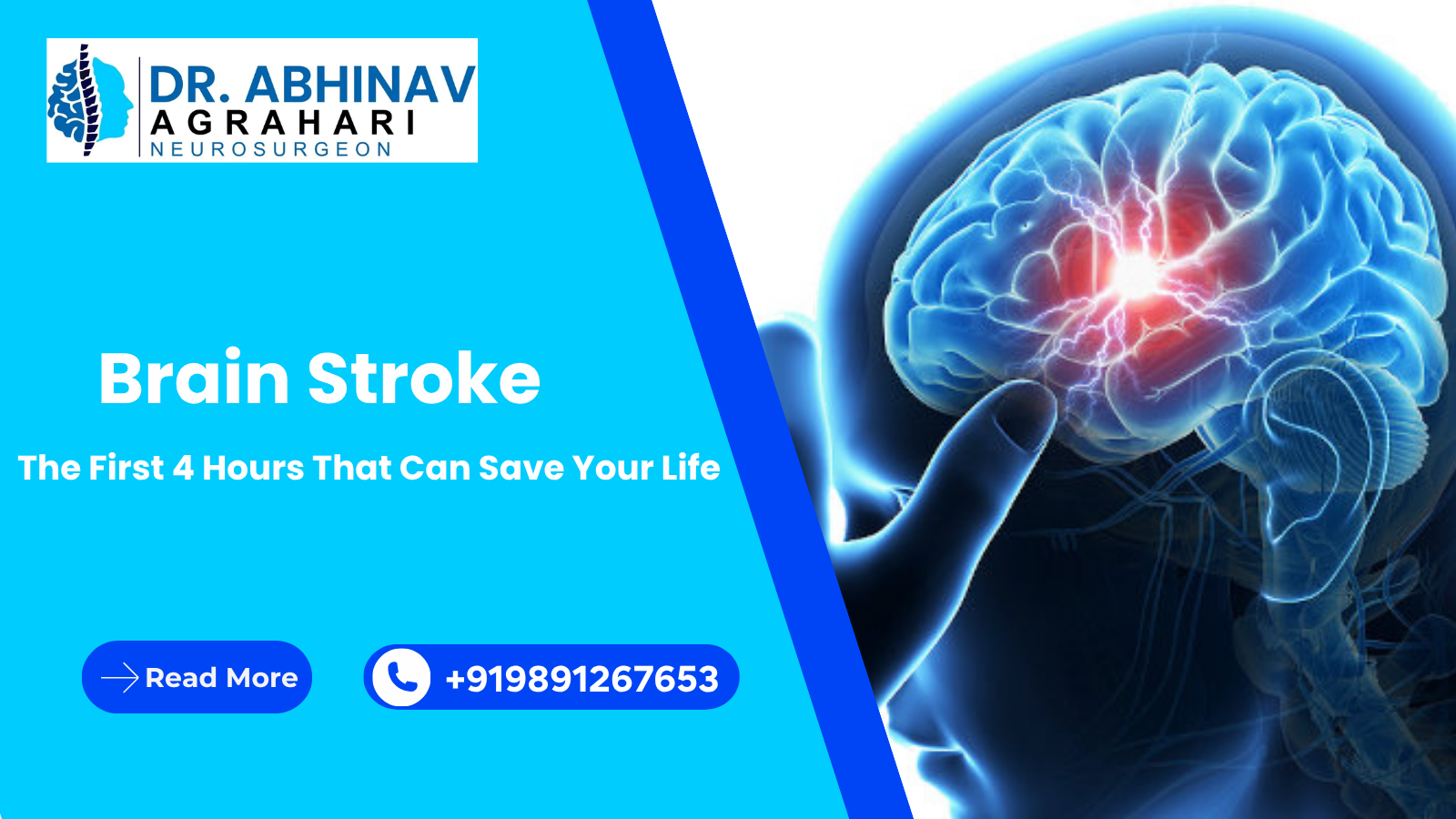
Brain Stroke: The First 4 Hours That Can Save Your Life
Every 40 seconds, someone in the world has a stroke. Every four minutes, someone dies from one. Yet despite being one of the most time-sensitive medical emergencies known to medicine, stroke remains one of the most misunderstood and poorly responded to conditions — particularly in India, where delays in reaching the right care cost thousands of lives every year.
The hard truth is this: what you do in the first four hours after a stroke begins determines whether a person walks out of the hospital or doesn't walk at all.
This is not an exaggeration. It is neuroscience.
What Exactly Is a Brain Stroke?
A stroke occurs when the blood supply to a part of the brain is suddenly cut off, either by a blockage or a bleed. Without blood, brain cells begin dying within minutes — at a rate of approximately 1.9 million neurons every single minute during an active stroke.
There are two primary types:
Ischaemic Stroke — caused by a blood clot blocking an artery supplying the brain. This accounts for nearly 87% of all strokes. The clot can form locally or travel from the heart or another artery.
Haemorrhagic Stroke — caused by a blood vessel in or around the brain rupturing and bleeding into the brain tissue. Though less common, it carries a higher mortality rate.
There is also a TIA (Transient Ischaemic Attack) — sometimes called a "mini-stroke" — where blood flow is briefly disrupted, and symptoms resolve within minutes or hours. A TIA is a serious warning sign that a major stroke may follow within days.
Recognising a Stroke: The FAST Test
Time is brain. The faster a stroke is recognised, the faster treatment begins. The globally recognised FAST acronym makes recognition simple:
F — Face: Ask the person to smile. Does one side of the face droop?
A — Arms: Ask them to raise both arms. Does one drift downward?
S — Speech: Ask them to repeat a simple phrase. Is their speech slurred or strange?
T — Time: If any of these signs are present, call emergency services immediately. Note the exact time symptoms began.
Other warning signs include sudden severe headache described as "the worst headache of my life," sudden vision loss or double vision, sudden dizziness, loss of balance, and unexplained confusion or difficulty understanding speech.
The First 4 Hours: A Window That Cannot Be Reopened
The Golden Hour (0–60 Minutes)
The absolute priority in the first hour is reaching a hospital with stroke care capability. Do not drive yourself. Do not wait to see if symptoms improve. Call for an ambulance immediately.
At the hospital, a CT scan or MRI will be performed to determine whether the stroke is ischaemic or haemorrhagic, because the treatments are opposite. Giving a clot-busting drug to a bleeding stroke can be fatal.
The tPA Window (Up to 4.5 Hours)
For ischaemic strokes, a clot-dissolving drug called tPA (tissue plasminogen activator) can be administered intravenously — but only within 4.5 hours of symptom onset. This is the most critical deadline in stroke medicine. tPA can dramatically reverse stroke damage, restoring blood flow and saving millions of neurons.
Patients in areas like Saket, Kalkaji, and Jasola in South Delhi benefit greatly from proximity to advanced neurovascular units. The best brain tumor doctor in South Delhi and stroke specialists in the region are equipped to administer tPA and begin neuroprotective care within this narrow window.
Mechanical Thrombectomy (Up to 24 Hours in Select Cases)
For large vessel occlusions, a procedure called mechanical thrombectomy — where a catheter physically removes the clot from the artery — can be performed up to 24 hours after onset in carefully selected patients. This has revolutionised stroke outcomes over the last decade.
Why Every Minute Counts
Research shows that for every 15 minutes saved in stroke treatment, a patient gains an average of one month of healthy life. Delays caused by ignoring symptoms, driving instead of calling an ambulance, or visiting the wrong facility can permanently change a person's outcome.
Patients in areas such as Okhla, Tughlakabad, and Badarpur needing urgent neurosurgical evaluation can access expert care from the best neurosurgeon in Okhla, who provides rapid assessment and intervention for stroke and related emergencies.
What Happens If Treatment Is Delayed?
Without timely treatment, stroke survivors face potentially permanent consequences, including:
- Paralysis on one side of the body (hemiplegia)
- Loss of speech or difficulty understanding language (aphasia)
- Memory loss and cognitive impairment
- Vision problems
- Depression and emotional dysregulation
- Complete dependence on caregivers for daily activities
The extent of disability is directly proportional to how long the brain was deprived of blood. This is why the phrase used universally in stroke medicine is simply: "Time is brain."
Post-Stroke Care and Rehabilitation
Surviving a stroke is only the beginning. The weeks and months following are crucial for recovery. A multidisciplinary rehabilitation team — including physiotherapists, speech therapists, occupational therapists, and neuropsychologists — works to retrain the brain through neuroplasticity, its remarkable ability to form new connections.
Medications to prevent recurrence, such as antiplatelet agents, anticoagulants, and blood pressure drugs, are also initiated. Lifestyle changes — quitting smoking, managing diabetes, controlling hypertension, and maintaining a healthy weight — are non-negotiable for preventing a second stroke.
For patients requiring advanced neurological rehabilitation following stroke or complex brain conditions, the best brain tumor doctor in South Delhi also coordinates long-term neuro-oncological and neurovascular care for patients with overlapping diagnoses.
Stroke Prevention: What You Can Do Today
Up to 80% of strokes are preventable. The risk factors are largely within our control:
- Keep blood pressure below 130/80 mmHg
- Manage blood sugar and cholesterol levels
- Quit smoking and reduce alcohol intake
- Exercise for at least 30 minutes most days
- Eat a heart-healthy, low-sodium diet rich in vegetables and whole grains
- Treat atrial fibrillation, which dramatically increases stroke risk
Regular neurological check-ups are especially important for those over 50 or with a family history of stroke. Residents across Okhla Industrial Area, New Friends Colony, and Greater Kailash can consult the best neurosurgeon in Okhla for preventive neurological assessments and risk stratification.
Conclusion: Four Hours. One Decision. A Lifetime of Difference.
A stroke does not announce itself with a warning. It arrives suddenly, silently, and with devastating speed. But medicine has given us a window — a narrow, precious window of four hours — in which the damage can be stopped, reversed, and in many cases, a full life reclaimed.
Know the signs. Act immediately. Get to the right specialist without delay. That single decision in those first four hours can be the difference between walking away and being carried away.
When the brain is under attack, every second spent waiting is a second of life lost.
FAQs
Q1. What is the first sign of a brain stroke?
Sudden face drooping, arm weakness, or slurred speech are the most common first signs. Use the FAST test immediately.
Q2. How long do you have to treat a stroke?
The tPA clot-busting drug must be given within 4.5 hours. Mechanical thrombectomy may be possible up to 24 hours in select cases.
Q3. Can a person fully recover from a stroke?
Yes, especially with early treatment and consistent rehabilitation. The sooner treatment begins, the better the recovery outcome.
Q4. Is a stroke the same as a brain tumor?
No. A stroke is caused by blocked or burst blood vessels. A brain tumor is an abnormal cell growth. Both require specialist neurological care.
Q5. What is the best way to prevent a stroke?
Control blood pressure, manage diabetes, quit smoking, exercise regularly, and get routine neurological check-ups — especially after age 50.

